Showing posts with label Musings. Show all posts

Thursday, 13 November 2008

Richard Walker & Chris Yates Get me Through the Night

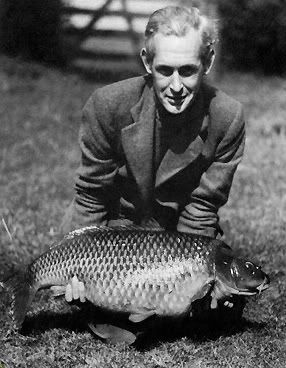
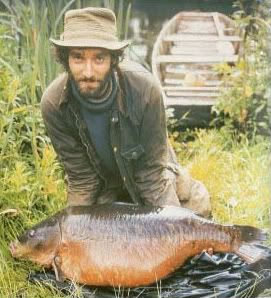
Richard Walker and Chris Yates display their record carp

All week I have been laid low by a diabolic illness. To make matters worse it is not the kind of illness which allows a couple of surreptitious days on the river bank; but it has kept me from work. To distract me while the malaise runs its virulent course I have taken the opportunity to re-read a couple of classics from angling’s literary canon.

First was Richard Walker’s Still Water Angling, first published in 1953. I read this book as a boy, choosing it as one of the weekly library picks we were obliged to take at school but, I’m ashamed to say, I can’t remember it making much of an impression. I recently purchased a copy of the fourth edition (David & Charles, 1975) and have been looking forward to reading it as an older and, hopefully, wiser angler.

Still Water Angling is often cited as seminal in that it states big fish may be caught more by design than luck. As a result the cult of specimen hunting was spawned. My impression, though, was that for all the precise instruction contained within the book, Walker’s ethos can be distilled into a basic set of rules based upon fundamental principles:

a) Locate big fish

b) Do not alert them to your presence

c) Present a bait to them when they are most likely to be feeding - taking the prevailing conditions into account

d) Ensure the tackle used is suitable to the job in hand

It is amazing how, fifty-odd years on, these basics are still ignored by many. Last summer, during a (thankfully brief) shower, I was almost blinded by the glare from a carp angler’s fluorescent orange Hi-Viz jacket.

Each chapter in Stillwater Angling deals with a specific species with, not surprisingly, almost half the book given over to carp, including the author’s account of the capture of his ‘44’. I enjoyed re-reading the book immensely, despite a narrative style which veers seamlessly between avuncular on the one hand, and hectoring on the other. But then, Walker could - and often did - boast a remarkable list of achievements, not least his contributions in the field of tackle design and development. He had earned the right to preach so, and the style is typical of the time.

Above all, Walker comes across as a ‘doer’. Unable to purchase rods suitable for big carp, he simply designed and made his own, a process which culminated in the MkIV Carp Rod, which became standard issue for serious carp anglers. Other gaps in the market led to the first electronic bite alarms and a lead for long range use – the arlesey bomb. Other innovations are too many to mention.

Chris Yates used a Walker-built Avon rod to catch his record carp from Redmire, as related in Casting at the Sun (Medlar Press, 2006), my second re-read of the week (Chris Yates has stated that, during his youth, he regarded Richard Walker as “our mentor”). Yates’ lyrical, relaxed style sits in marked contrast to Walker’s. Casting at the Sun is less a book of instruction, more a series of impressions arranged as a roughly chronological memoir. I think what makes it the favourite of so many anglers of my generation is really quite simple – having read it, many of us want to be Yates.

If Stillwater Angling brought science and engineering into the equation as problem solving tools, Casting at the Sun subtly explores the reasons behind why men fish (women appear only fleetingly in both books), and contains comparatively little in the way of detailed technical information or methodology. Indeed, Chris Yates would have us believe that a well honed instinct, rather than sheer ability, lies behind much of his success. Richard Walker, too, was not averse to this kind of thinking: this from the chapter on carp in Stillwater Angling:

But specialist carp-fishers develop what almost seems to be a sixth sense, which tells them when a carp is near the bait…I am always aware of a sort of deathly hush just at the moment before a big carp sucks in the bread; many other carp-fishers have had the same experience.

The period covered in Casting at the Sun - the mid 1950s to 1980 - ostensibly bridges the gap between the ‘old’ times and the ‘new’. But by the end of the book Yates is applying the same fundamental principles he learnt at the beginning (those espoused by Walker) using much the same tackle. In this, at least, the two men are similar. They both came out of left field – just different parts of it.

Many people say the first part of Casting at the Sun is their favourite. Readers see parallels with their own boyhood fishing adventures. Certainly, if embellished by Yates’ lustrous prose, some of my own early experiences might not appear out of place here. But, as the author says in the foreword to the 1995 edition, the book: -

“…still reads well as a study of near psychotic obsession…”

The obsession is, of course, with carp and, for me, the most gripping part of the book deals with Yates’ two periods as a member of Redmire syndicates. The first spell sees him and Rod Hutchinson seemingly vying with one another to see who can be more unorthodox in their approach to carp fishing. The second describes a more grounded angler, having conquered his obsessional tendencies, returning to Redmire and an appointment with destiny – fabulous stuff.

Between these two intense sections other experiences are beautifully described. I particularly like the part where he's scouring the Surrey countryside on a folding(!) ex-army moped, looking for new water to fish.

I always enjoy reading Casting at the Sun. It makes me want to grab a rod (cane, naturally) and cycle off in search of some long forgotten carp lake, even when I’m lying in bed at 10.30pm on a cold November evening, shivering, and snotty.

Two things struck me during this latest reading. The first was that I had, this last summer, fished a stretch of the Mole blissfully unaware that it was, surely, the same one described in the chapter entitled River Interludes (a great day’s fishing it was too – bread flake, a single shot pinched on, trundling it through, chub, roach, meadows, swallows, sunshine – thanks James). The second was re-reading the following sentence, taken from the chapter entitled Redmire Reflections:

The eels were also irritating because of their great delight in anything the slightest bit wormy, maggoty or meaty.”

Which is embarrassingly similar, if you care to look, to a sentence I wrote in the last piece for this blog. I swear I didn’t consciously plagiarise it, but it’s a strange coincidence, and goes to show, perhaps, how a well turned phrase can become lodged, indelibly, in one’s mind.

Next it’s ‘BB’s Confessions of a Carp Fisher, followed by Walton. Hopefully they’ll get me through ‘till Saturday, when I hope to be recovered sufficiently to try for a barbel.

P.S.
For those interested in angling literature, but who cannot afford - or who are not prepared to pay! - the prices asked for some of the older classics, I heartily recommend the following website http://openlibrary.org/. It is a Beta site, run by the Boston (US) Library, which makes books available, in scanned form, free of charge. I was able to read Coarse Fishing, by H.T. Sheringham, and North Country Flies, by T.E. Pritt in their entirety. Just use the search function on the homepage.

Monday, 10 November 2008

[W]eel be Seeing You

Last Thursday afternoon I experienced one of those blissful moments that come along every now and then and brighten one’s life: like getting out of bed to prepare for work only to remember at the last moment that, in fact, it’s Sunday; or finding a tenner in your pocket when you go to put your trousers in the laundry basket. I discovered, to my joy, that my employer owed me two days holiday, rather than the one I had supposed must sustain me until the end of the year. I immediately booked the next day off.
I determined to revisit Nafford, scene of my piking failure the previous week, with the intention of trotting for Chub and Roach. Unfortunately (but not altogether surprisingly, given the previous night’s heavy rain), upon arrival the water was too coloured, and a bit too high, to suit that method. The fish, I thought, would stand little chance of seeing a small moving bait.

Switching to plan B – fishing a static, smelly bait - I set up a 12’ 1.5 T.C. rod (Greys Prodigy Specimen – a versatile piece of kit, in my opinion) and cast a hair-rigged 15mm halibut pellet, held down with a 2oz lead, under the willows on the opposite bank. I set the rod at 45° in the rests and set the free spool function on the reel. I imagined chub, if anything, would take the bait. I catapulted a few free offerings over the top. I then began to set up a second rod with which I intended to fish an open-ended feeder filled with smelly ground bait and turmeric-dusted maggot on the hook. Roach were the target.

As set up the rod, I thought about the conversation I had conducted with a friend the previous afternoon, via the medium of Yahoo Messenger. Naturally, I had told him I would be fishing the next day. Our conversation drifted from fishing in general to the plight of the european eel in particular and its undoubted decline in local waters since our boyhood. Then, any maggoty, wormy, meaty bait, fished on the bottom, would more likely be taken by an eel than anything else. Indeed, when I think of my boyhood fishing, the eel, perhaps, looms larger than any other species in my memory. I became pretty handy at dealing with them too; learning how to recognise the characteristic bites early and to strike before it was ‘too late’. Thus I was able to return the great majority of them unharmed to continue their remarkable life cycle. I told my friend that I had not caught a single eel all season.

So there I stood on the bank side, pondering, not for the first time, the reasons behind the decline of the eel, when the sound of the spinning baitrunner snapped me from my reverie. Something was steadily taking line. A glance out across the river showed my line had not been snagged by flotsam. Picking up the rod I tightened and struck. Immediately, I felt the unmistakable rhythmic tug of an eel – not a bad one either, at 1 1/2lb. Thankfully, it was cleanly hooked in the lower lip and, although it liberally coated the right forearm of my jacket with slime, was easily dealt with.

Apart from being struck by the coincidence, my heart was truly gladdened by the sight of that eel. I weighed it, took a picture, and returned it lovingly to the water.

I spent the rest of the day catching roach and bream on the feeder. I whiled away an hour freelining some luncheon meat through the weir pool, but failed to strike quickly enough to the two bites I had – great thumps though they were. The eel of the first cast, though, was the fish of the day.

Monday, 3 November 2008

Plugging Away at it


Faced with a busy weekend of Halloween shenanigans and other merry-making and with only Saturday morning at my disposal I decided, on a whim, to go lure fishing. Some months previously a friend had given me, very generously, a load of plugs, lures and spinners. It had been years, though, since I had fished for pike.

We are released from the office at four on Fridays so I headed straight for my local tackle emporium, shelled out some of my hard-earned on a 10’ lure rod, some traces and – unable to resist – more lures.

I arrived at my chosen spot – Nafford Lock, Eckington – and upon arrival at the bank side was pleasantly surprised to find I had the place to myself. A further good omen was the sight of a pike bung lying in the frozen grass; a sign that pikers had recently been around. Pocketing the float, and flushed with a sense of kinship to those – probably brilliant – pike anglers, I sallied forth toward the weir pool next to the lock.

I’d brought a Shimano Baitrunner reel to use, purloined from my carp gear. Not ideal, I know, but it was the most appropriate thing to hand and was already loaded with brand new 15lb mono. I strapped it to my new rod – also a Shimano as it happens (A Katana BX 300 MH, for goodness sake) – threaded the line, tied on a trace and opened my box of lures. It was here that the trouble began.

I’d brought my de-barbing pliers and, having selected a lure, set about the task of flattening the barbs. My mistake was failing to take off my woollen fingerless gloves before starting. Immediately – inevitably – I got a treble stuck fast in the palm of the left glove. Maybe I was still a bit groggy from the Halloween celebrations the night before; clearly, I should have removed the right glove at that point: I did not. My attempts to extricate the hooks from the left glove served only to get the right glove hopelessly snagged as well.

After a frustrating ten minutes involving much wielding of the de-barbing pliers I managed to liberate the lure from the offending hand wear. Petulantly, I stuffed the gloves into the deepest pocket of my bag, resolving to ignore them for the rest of the session, despite the cold.

Ready for action at last, and with a resurgent confidence which, in retrospect, bordered on the preposterous, I cast across the weir pool and retrieved: nothing. Nothing then, and nothing for the next three hours. I changed lures until I’d used them all; I varied the retrieve to the very limits of human imagination; I cast into every likely spot on the stretch; I flagged down a passing narrow boat so that the heroic crew could untangle my lure from a willow on the opposite bank (which had imperceptibly lurched nearer just before I attempted to cast beneath it). To make matters worse, the nagging pain of tennis elbow (which I had contracted after a particularly vigorous day of fly casting tuition nine months ago, and which I thought had gone) increased insidiously throughout the morning.

Finally, conceding defeat, I sat down on the bank and rolled a cig. Suddenly more reflective, I began to notice what a lovely looking stretch of river this was. Downstream from the weir pool the river narrowed and the flow increased. I began to regret my rash decision of the previous afternoon. I would have been better off, I reflected, if I had bought some maggots and casters; if I had resisted the siren call of those flashy, gaudy lures, at the tackle shop. The conditions were ideal for trotting a stick down through those gentle, inviting glides. I vowed to return on a different quest another time, to wield a ‘pin in search of roach and chub. As I bent down to pick up my bag, the bung fell from my pocket onto the grass. I left it there, for some reason, for someone else to find.

Thursday, 23 October 2008

The River Lugg in Autumn

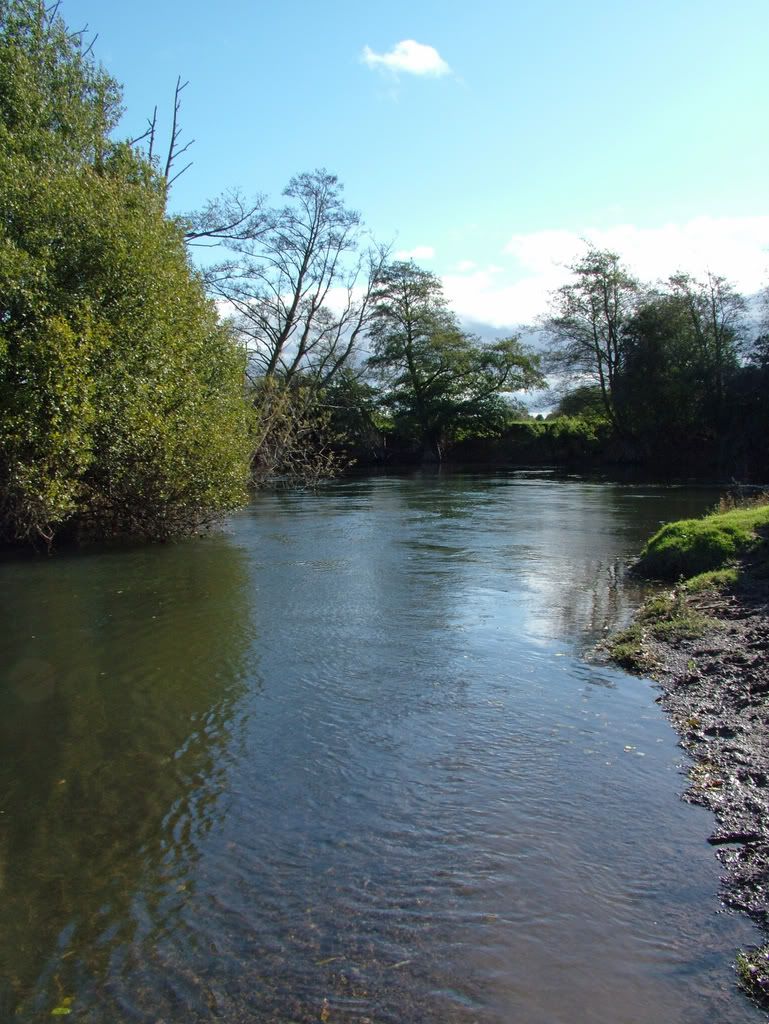
Access to the River Lugg, at Marden, Dinmore, and Moreton-on-Lugg, a couple of miles north of Hereford, comes as part of the BAA ticket (which, incidentally, represents excellent value for money, with over 60 fisheries to choose from). This tributary of the Wye has much to offer. Here, the Lugg flows through beautiful, often wild, countryside inhabited by kingfishers, otters, and several varieties of wild duck. It is better known for its game, than its coarse fishing.

The BAA website states there are grayling present, so I set off with the idea of some autumnal long trotting in mind. Parking facilities for all three sites are non existent, making roadside parking unavoidable. The roads are quiet and fairly isolated so (without wishing to cast aspersions upon the good citizens of the area) I was careful not to leave any tackle visible in my car. I had come lightly armed in any case, knowing I would be doing a lot of walking, moving upstream from swim to swim, trying each likely looking area.

This was my second visit – the first was during the penultimate week of last season. That trip was memorable for the unexpected capture of a hefty chub. I was trotting a 5BB Avon down through a swift glide that took it beneath an overhanging hawthorn bush. I had caught (and returned) three small brown trout in as many casts on double red maggot and was having great fun, hooking all three fish at the end of the trot. On the fourth cast the float disappeared almost as soon as it landed on the surface and I struck instinctively. The chub took off downstream with a rapidity that shocked me from my nonchalance.

At first, there was little I could do, fishing as I was with a mere 2lb 3oz hooklength to a barbless fine wire size 18. Eventually I was able to impose myself more forcefully upon the fish, which by now had taken fifteen, maybe twenty, yards of line. Realising there would now be a fair amount of stretch available in the monofilament I dropped the rod tip and applied as much upstream pressure as I dared in an attempt to stop the fish making further downstream headway (the river was fining and relatively high, with a swift flow). Eventually I succeeded in subduing it.

At this stage I had no idea what it was. I was convinced it wasn't a trout, and thought I may have hooked a small salmon or barbel. At no stage during our tussle did it head for the undercut of the bank in classic chub style, remaining, instead, in the middle of the river, barbel-like, where the flow was strongest. After a battle of, perhaps, five minutes (though it seemed longer at the time) the fish finally rolled on the surface, revealing itself as a golden-flanked chub. It was still six or seven yards downstream but remained docile.

Heaving its dead weight to the net, against the current, was the most nerve-wracking part of the fight. One powerful lunge, I thought, and I'd lose it. I was not carrying scales, but the fish was easily over 5lb and in perfect condition. The hook had come out in the landing net and I held the chub with its head to the current for a few seconds before it soaked me with a strident slash of its tail and swam away; annoyed, but free.

This, my second trip, was less successful in terms of poundage banked, accounting for one trout only – and an out of season trout at that. It was, however, a very nice 'wild' brownie – I'd estimate it at just under a pound – and it led me a merry dance. I managed to unhook the fish while it was still in the net, in the water, without handling it.

That trout accounted for the only bite of the day. As can be seen from the pictures, however, it was far from a wasted expedition, and I shall be going again soon.

Birmingham Anglers Association

Thursday, 2 October 2008

The Exuberance of Old Age


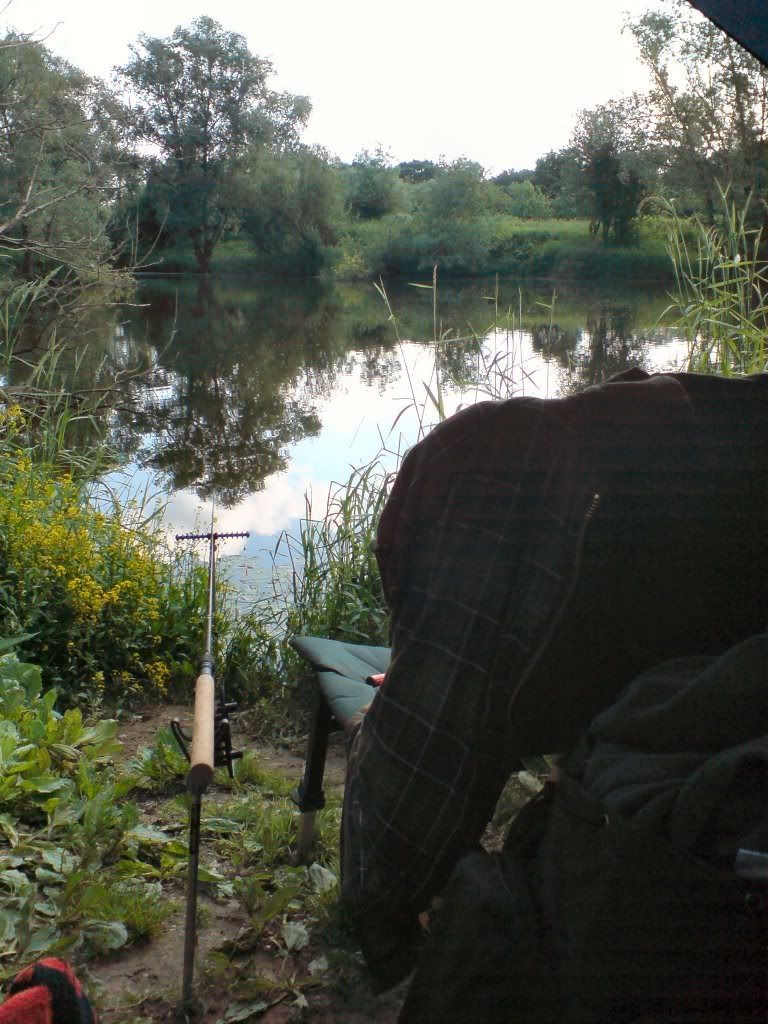
Last Saturday I was fishing at one of my favourite spots, the subject of the photograph at the head of this page. There are two old brick pits, close together and adjacent to Big River. The fishing is varied – and difficult. At least, it is difficult to catch fish of a decent size, of which there are many. In early season, tench may be had by early risers, followed by decent bream, roach, perch and rudd throughout the day, if the correct methods are applied, and well.

Between the two pools there are many fishable pitches, but far fewer are the number fished often by regulars. The regulars (and I count myself as one, having fished the place since the 70s) know by experience where best to gently cast a bait, usually into swims where the bottom falls away into deeper holes.

I had spent the morning enswathed within a cold, stifling mist, failing to catch tench, although there were certainly tench in my swim. I was not despondent, however: many fish had come to the net and, although the intended quarry had not been among them, I was content within the peaceful and eerily beautiful surroundings.

At about 11.30 the sun, which had been attempting all morning to evaporate the wet, grey blanket of fog, finally broke through. With astounding rapidity the shroud dispersed and gentle shivering turned to languid basking as the temperature rose.

It was at this point that I became aware of a plaintive voice coming from the levee behind me. The speaker was partly obscured by foliage, but he was asking if I’d mind if he “squeezed in next to me”.

I was taken aback, to put it mildly. I was fishing from a tiny promontory where, at a push, I might have acquiesced to a like-minded close friend joining me. I had not, however, imagined sharing the space with anyone else. I had assumed, having planted my flag at 6.30 am, that I would have the pitch to myself for the remainder of the day. This chap had some neck, I thought. I sputtered something about it being Okay, whilst attempting to conceal my true thoughts concerning the awkward position in which the fellow placed me.

He made his way down the bank; it became clear that he had stopped at the bottom; there followed an uncomfortable hiatus. I turned to face him.

There stood one of those characters who, for no easily explained reason, evokes profound sympathy. A little old man, much older than I’d expected – perhaps pushing eighty – wearing thick spectacles, wellingtons and a flat cap. The row of gold incisors in his lower jaw glinted in the sunlight. My initial thought was to wonder how he’d made it across the fields unsupervised. He stood, tackle bag over one shoulder, holdall over the other, staring dejectedly at what he saw, which was me, fishing the pitch upon which he, clearly, had set his heart.

After a further uncomfortable pause I said, “Alright?” as brightly as I could, eager not to compound his despair.

“Oh,” he said, glumly and, I thought, slightly pointlessly, “you’re fishing there are you?”

It dawned on me that, not only had he wanted to fish from my little promontory, he wanted also to fish the exact spot where I had chosen to cast. Feeling faintly ridiculous, and gesturing vaguely at my float, I informed him (I'm ashamed to say in the manner of one addressing a particularly dim child) that, actually, I was fishing the area he so obviously coveted.

By now, the initial surge of his disappointment having evidently subsided, and, having regained, as a result, a little composure, he offered wistfully; “I had forty-odd fish out of there Wednesday afternoon...”

“Oh… what kind?” I asked, unsure which direction the conversation was taking.

“Small roach and perch – I had a bream on - ‘bout three or four pound, but I lost him.” he continued in the same detached manner. “Oh well,” he sighed, apparently now resigned to his fate, “I’ll go and fish the other pool.”

“Good luck!” said I, a little too quickly.

As soon as he had gone I began to analyse our interchange. Had he, and I, acted entirely scrupulously? Initially, I had felt that the old boy had a bit of a nerve. I was clearly in the pitch; I had baited the swim and had risen at quarter to six that morning to ensure I got it.

He, on the other hand, had turned up halfway through the day, and had admitted fishing the spot only three days previously. Presumably, being well past retirement age, he was able to go fishing as and when he pleased. I, unfortunately, am incarcerated in an office on weekdays.

He had not been impolite. When he left me I had heard him talking to a couple he clearly knew, who were walking their dog along the riverbank, informing them cheerfully that "…that gentleman…" (me) was fishing where he had wanted to go.

I concluded that, while I was within my rights to stand my ground, his momentary loss of composure could be wholly forgiven, as it was surely a manifestation of his undimmed enthusiasm for fishing. Was it not heartening that the old man's excitement still burned so brightly, even at his advanced age? Was it not wonderful that the rashness and exuberance of youth still bubbled so close beneath the surface?

Wednesday, 1 October 2008

Harbour Fry


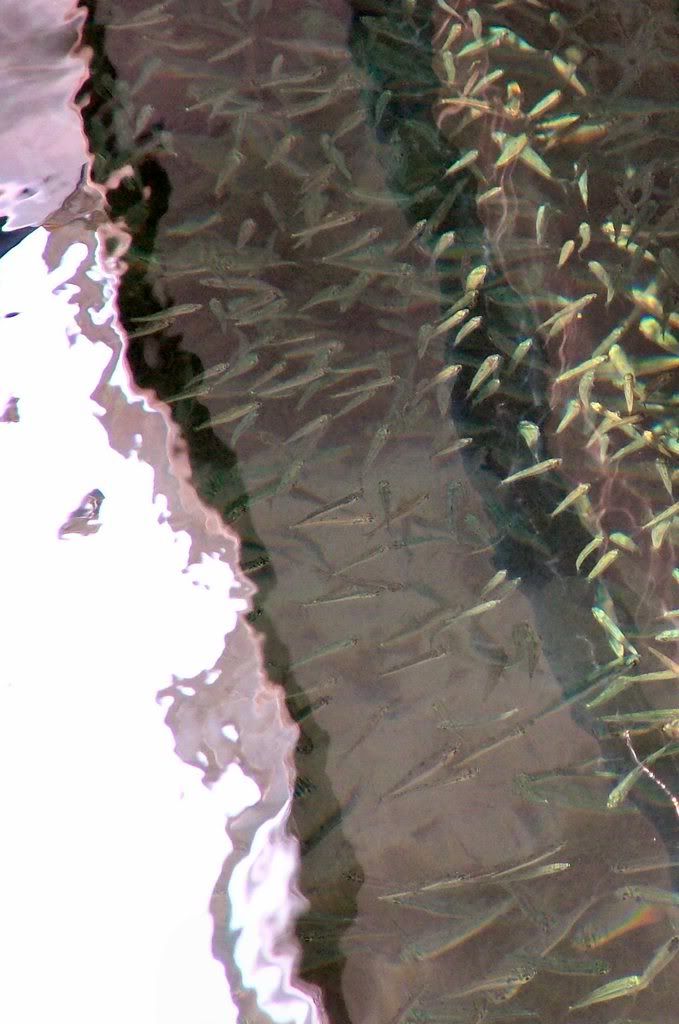
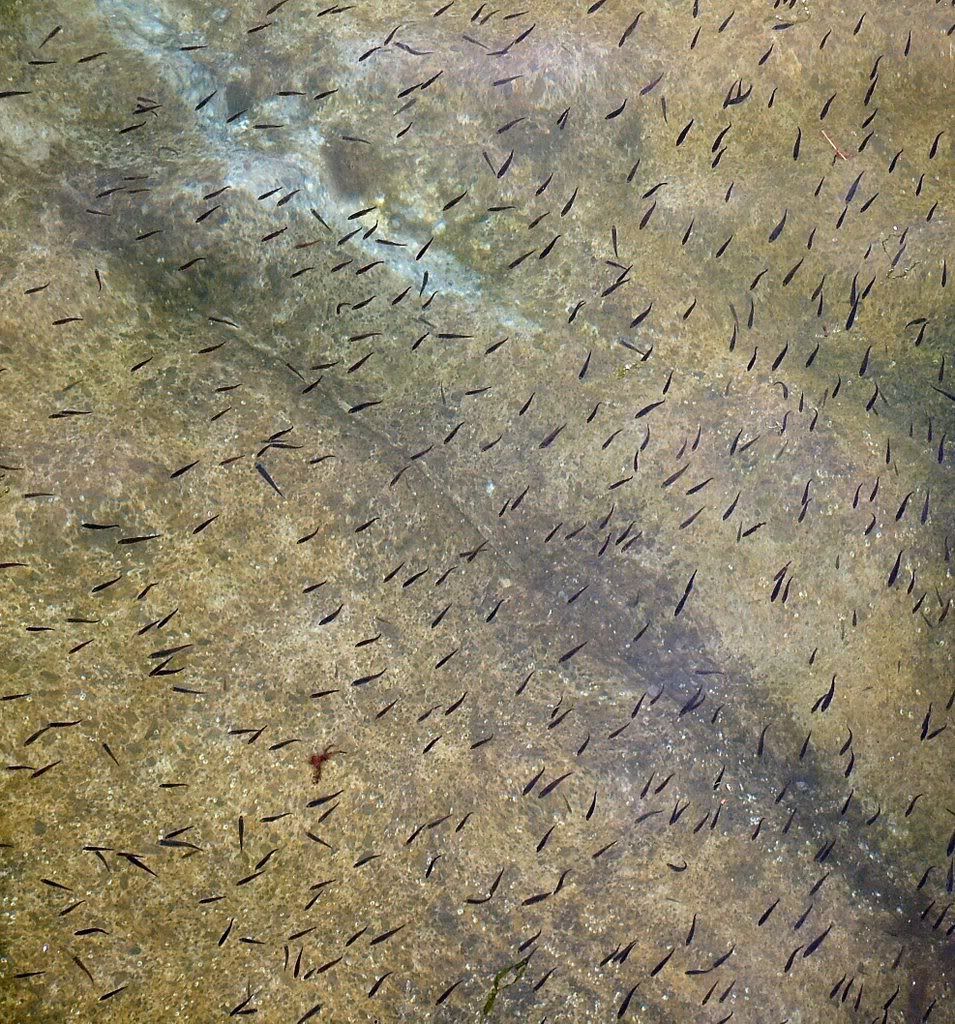
Shoals of fry make interesting shapes gathered around piers and beneath fishing boats before leaving the safety of cover and venturing out into the ocean.

Above, Aponisos, Agistri, Saronic Gulf, Greece. Below, Portree, Skye, Scotland.

Thursday, 18 September 2008

Closed Season Chub


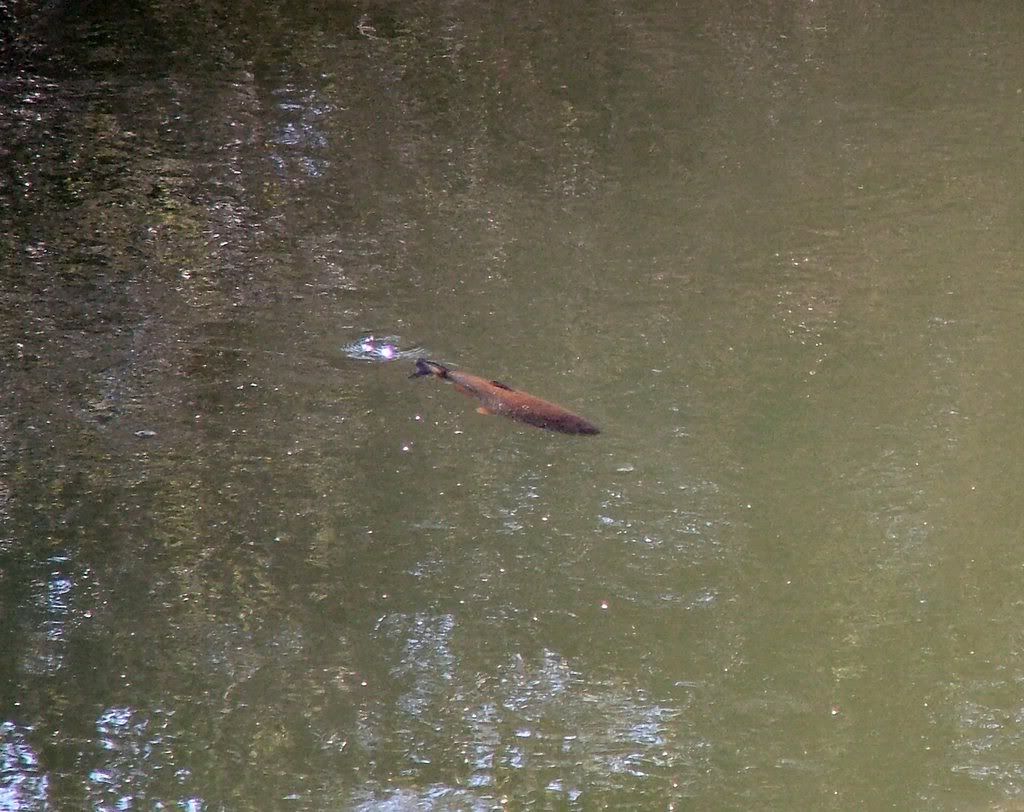
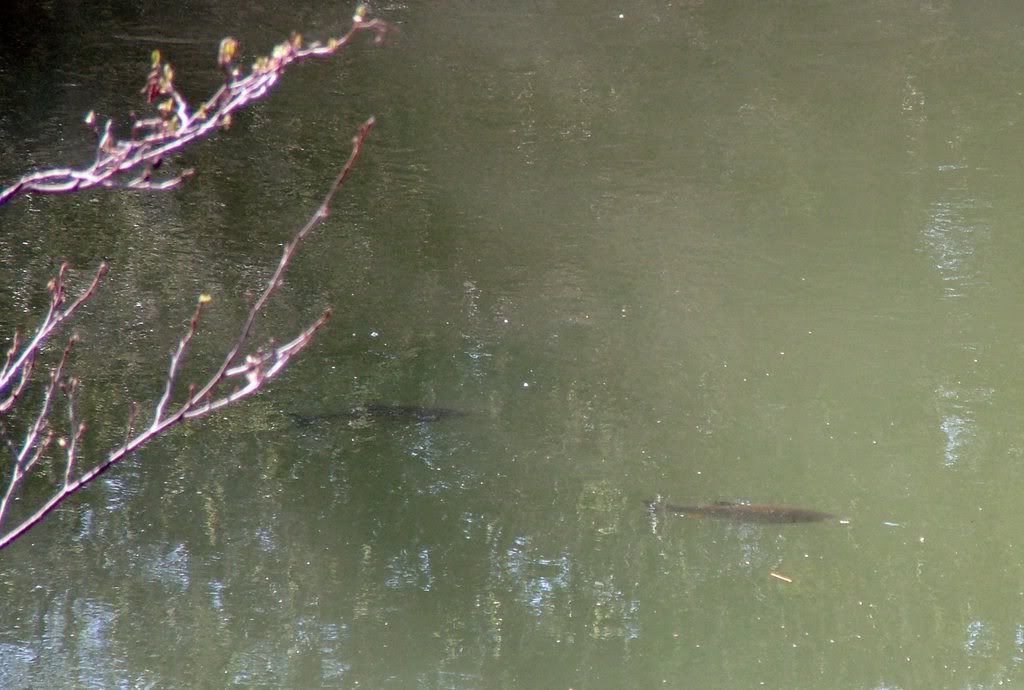
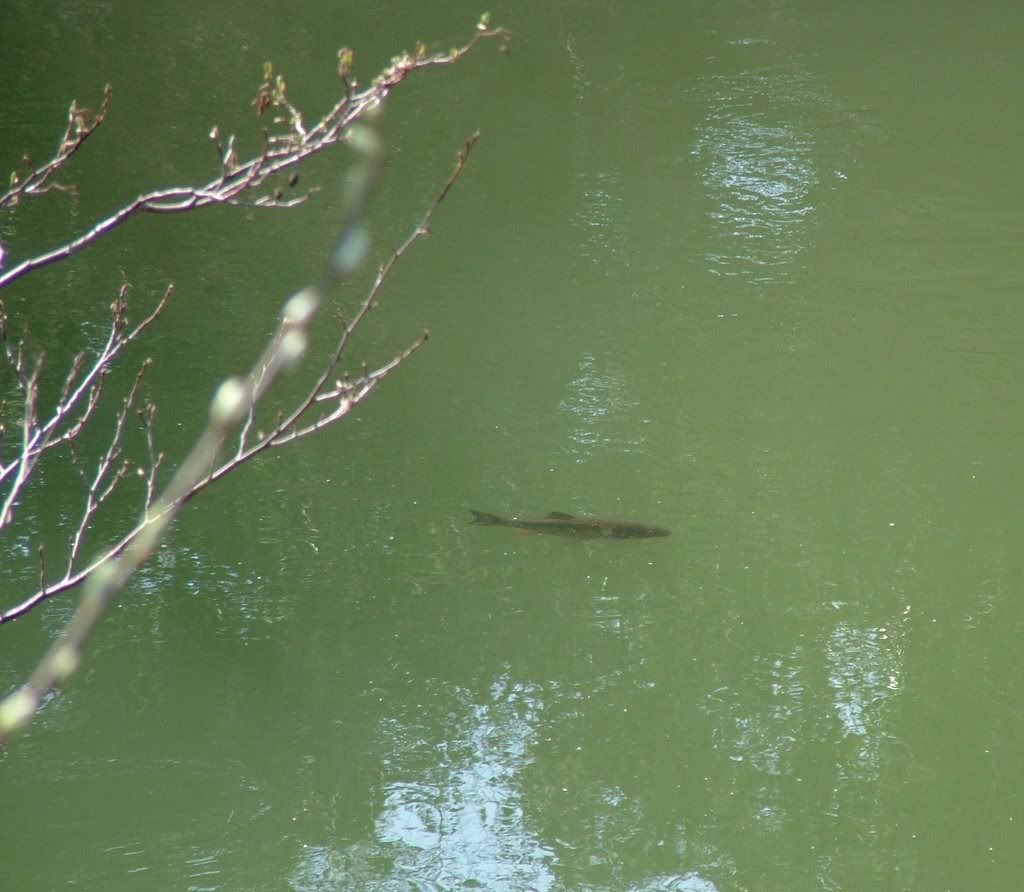
These chub were spotted during a closed season stroll along the banks of the River Teme near Worcester last year. There was a shoal of between 20 - 30 spread across the width of the flow. They were clearly taking insects off the top (the first picture shows a fish having just risen) and appeared to be enjoying themselves immensely.

In fact, in some uncanny way, they appeared to know it was the closed season. Far from being the most "...fearfullest of fishes..." they were disporting themselves in what can only be described as a la-de-da manner. These fish were no inexperienced youngsters either. I estimated them at between 4 - 5 lb.

Is it possible that fish know when it's the closed season? Or were they so preoccupied with their feeding that they failed to notice me, sillouetted in the bright May sunshine, photographing them?