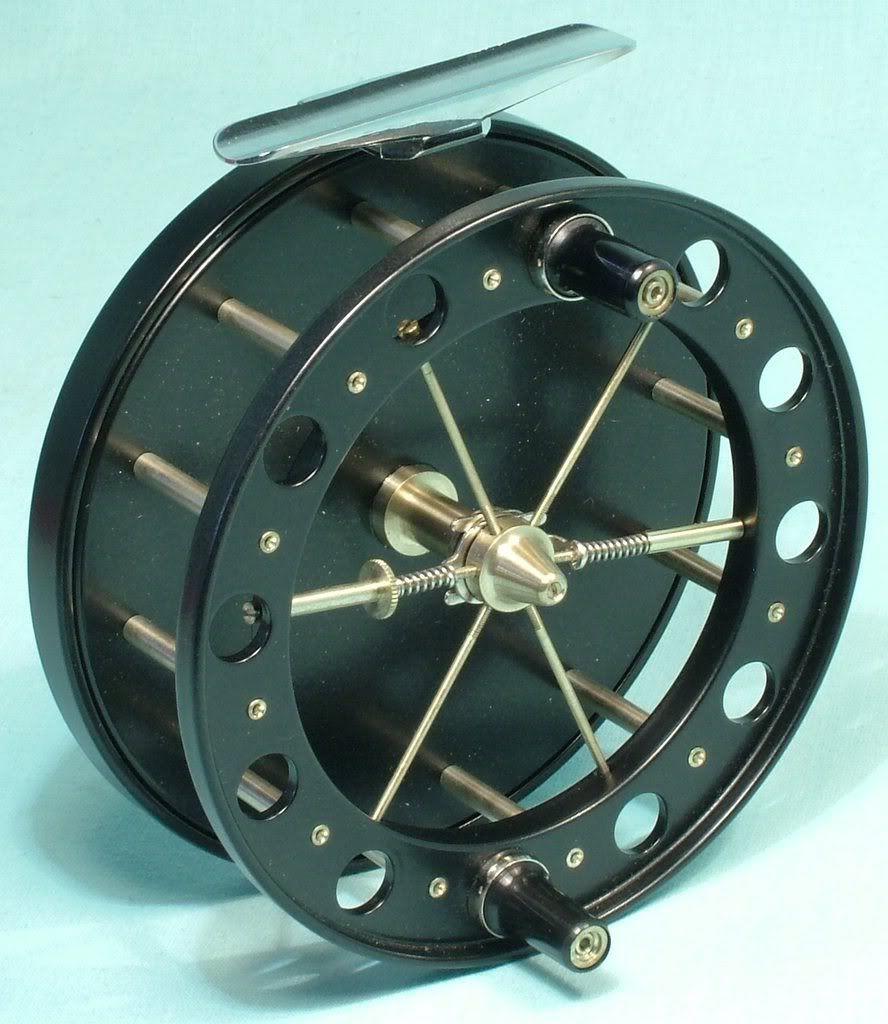
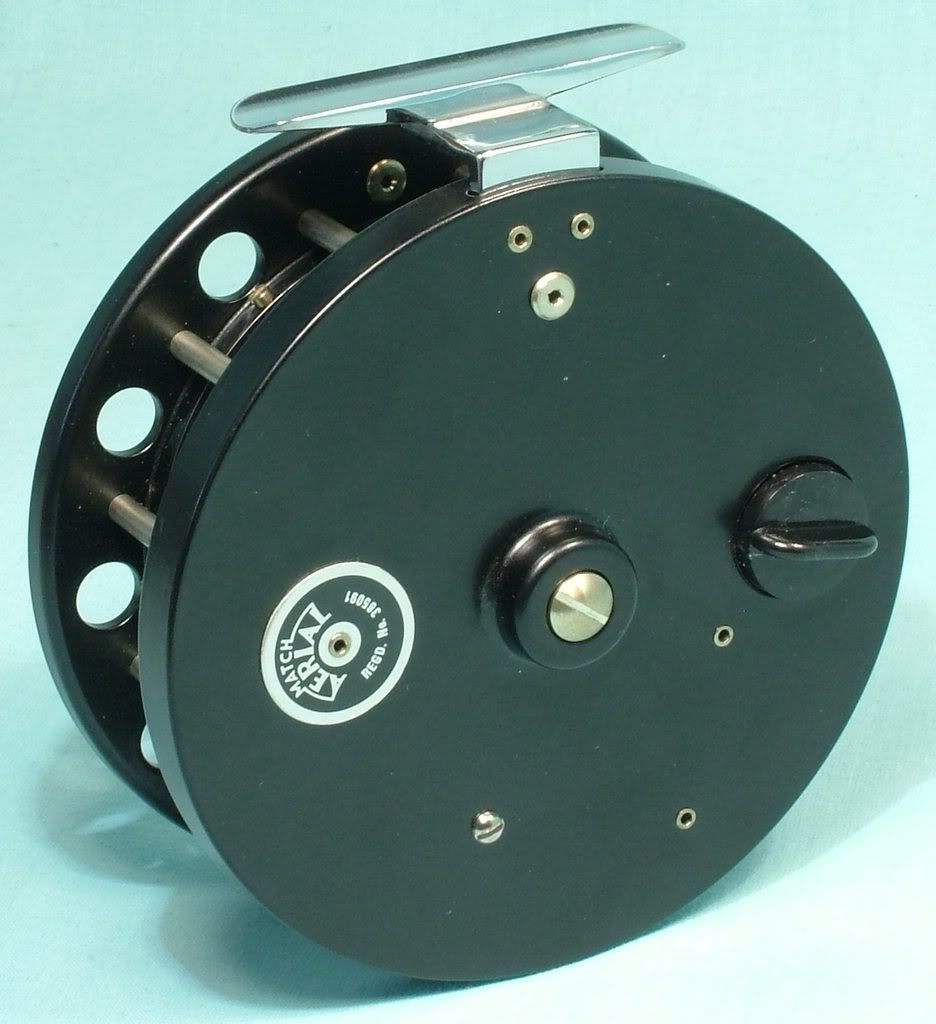
The Fred Crouch Match Aerial is, to all intents and purposes, a replica of the last Allcock Aerials to be produced. From information garnered form the internet, it appears that Fred Crouch (who is famous for his barbel angling expertise, and who may, or may not, have worked for Allcock) was given the licence to produce them and continues to do so. Previous incarnations were called "The Jet" but this example has just "Match Aerial" on the Allcock-like nameplate. The reel under review is a 4.5" wide drum model.
I was looking for a centrepin to use for barbel and carp fishing and, having looked around and taken advice, decided upon the Fred Crouch Match Aerial – not least because of the price. I found this one on Ebay, new, for £125 plus £4.99 P+P. However, they are on sale for considerably more. At the time of writing there is one offer on Ebay for £199 so, as always, my advice would be to shop around.
The reel came in a varnished plywood box. The foam lining, with cut-outs for the handles, is tightly packed and holds the reel very securely. Anglers who use the reel regularly will probably have no further use for the box for storage: it makes a great container for bits and bobs, however – fly tying materials for example – when the foam's removed. Presumably the box is for collector types to display their reel in a nice display case. Other suppliers mention the reel is supplied with a certificate of authenticity. Mine wasn't, but I have no reason to assume it's not the real deal (pun intended). I believe it to be a genuine Fred Crouch Allcock Match Aerial replica, if that makes sense.
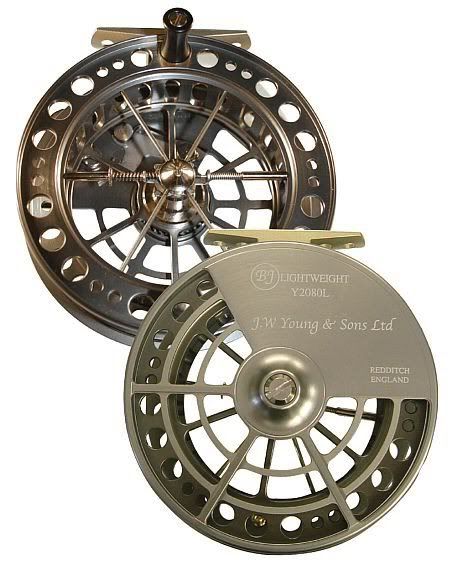
Taking the reel from the box the first thing that strikes me is the chunkiness: this is quite a chunky reel. I popped it on the scales and it weighed in at 300g exactly. I am not saying that it is too heavy; in fact, as far as my requirements are concerned, chunkiness is a positive advantage. It feels like a substantial reel that means business. If, however, you're looking for a lightweight trotting reel, capable of delicately presenting a single caster beneath a petite stick float to sniffy, finicky roach, then I would opt for something more akin to the BJ Lightweight reviewed here. This is an old-fashioned reel by today's standards, but it's a classic design and one that has served anglers' needs for many years.
The construction (as far as I can discern) is as follows:
The spool and body/backplate are of bar stock aluminium (meaning they are not cast, but machined from solid metal). They are finished in black powder-coat. The spokes and hub are of nickel silver and the centre pin itself is steel – as are the ratchet components. The foot is 2-piece, chrome-plated, and may well be brass beneath. The click check switch is black plastic, as are the handles, which are not removable.
The reel looks great, and has the timeless aesthetic appeal which accompanies any classic design. Personally, I would argue that the wide drum version has better proportions than the narrow. To me there is something more utilitarian, more workmanlike, about it. Perhaps this is because I favour wide drummed 'pins in use. I have never perceived the need for a narrow drum specifically. I find them harder to control as a result of the rim being further underneath the rod handle (I hold the rod/reel over the top rather than from behind, as it were) and can see no benefits that a narrow drum might bring.
The Fred Crouch Match Aerial is a true centrepin - there are no ball bearings – the spool rotates upon the pin and herein lies the source of much of the debate that circumscribes centrepin lore. Many generalisations have been touted concerning what does, or does not, constitute the criteria for a good, or bad reel. The truth, of course, is that much depends upon what is required of the reel in question. Here are my own generalisations:
For trotting, what is required first and foremost is low inertia take-off from the spool. In other words, the action of a relatively light float working against the reel will start the spool spinning and peel line from it. Secondly, the spool should carry on rotating freely, but not (generally speaking of course) overmuch, as the float is carried downstream. If the spool is too free running it may overrun, resulting in loose line between the angler and the float - or worse, a tangle. Generally speaking (again) what the angler is looking for when trotting is for the action of the turning spool to work against the float such that the float is held back, somewhat, relative to the surface current. As a consequence of this the bait will be slowed to the speed of the current at depth which – generally speaking – will be flowing slower than that at the surface. Thus the bait will appear to the fish to be more naturally presented or, to put it another way, as if not being presented at all but, rather, as if it is being borne naturally along by the stream.
The other time when a free running spool is an advantage is when performing the fabled Wallis Cast. Here, it is vital that the spool continues to spin freely throughout the duration of the flight of the terminal tackle until it is stopped by the angler. It will be seen that neither occasion requires that the spool remains spinning freely for two to three minutes. In most other circumstances an overly free spinning spool can be an inconvenience.
It is almost impossible to read about any given centrepin reel without the obligatory mention of spin time obtainable, the spool having been given a ‘smart bat’ or some such (whatever that, or other similarly unscientific terms may mean). It is not uncommon to hear of two to three minutes of spin being cited. These claims are probably true, but in practice mean little. What is important is that the spool can be set to spin with little reduction in speed for a few seconds at most; that the force required to overcome the inertia of the spool and start it moving is minimal; and that the spool continues to rotate as a result of the pull of the tackle upon it.
Although I have yet to use this reel for trotting (and with the proviso, touched upon earlier, that it would not be my ideal choice for trotting with lightweight tackle), it is clear The Fred Crouch Match Aerial conforms to these criteria. I took the reel on a carping expedition the day after taking delivery. In preparation I had (very) lightly oiled the spindle with sewing machine oil and loaded it with approximately 60 yards of 8lb monofilament. Matched with an 11’ Avon rod I fished the margins of the pool, legering with bread or sweetcorn as bait. I was able to swing the terminal tackle to most of the spots I wished to try. The occasional cast required that I pull line from the spool as I swung out the terminal tackle – not a Wallis cast as such, but Wallis-esque enough to tell me that the reel would respond well should a ‘Full Wallis’ be required.
Christening a reel is always a special moment. The Fred Crouch was blessed by a lively little common of about four pounds, the first of five or six of similar size. Playing the fish using thumb pressure was extremely comfortable due to the wide drum’s smooth, broad rim and the reel responded very naturally to my controls. I only have two gripes. One is that the noise of the click check, as supplied, was beyond raucous when the fish made its initial run. This, though, can be easily remedied by reducing the pressure of the spring in the mechanism which acts upon the pawl, and is certainly a job I shall undertake before taking it barbelling. Left unadjusted the din might put down fish for miles around. The second is that the click check switch, located on the backplate, has a bit of a cheapo, plasticky look about it. Having said that, in practice it functioned, and felt, perfectly serviceable.
In conclusion I have to say that the Fred Crouch Match Aerial is outstanding value for money. It may not have the flashy cosmetic appointments of other centrepins on offer, but this in no way detracts from its usability. Then there’s the price, which compares very favourably with its competitors. The recommended retail prices of J.W. Young’s centrepins are almost twice the price paid here. At the upper end of the price spectrum the reels produced by Chris Lythe and Gary Mills, for example, (while undoubtedly masterpieces of form and function – and I know I’ll have to order one eventually) can cost four times as much as the Fred Crouch.
Using this reel, one has a palpable sense of being part of a history stretching way back to the first aerials of the 19th century, through their subsequent development and refinement until the ubiquity of the new fangled fixed spool reel saw Allcock ending production in the early seventies. My advice? – buy one.